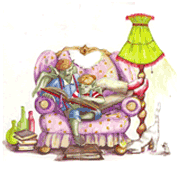
The Vowel First Method
Author: Minna Trower
A simple but highly effective method that teaches
reading to students with learning problems.
 This remedial program is applicable for students with reading problems resulting from various origins such as learning disabilities (including dyslexia), a developmental lag or a borderline intellectual disorder. It accommodates students of all ages – youngsters through adults. To address this wide range of age, the Program has two titles (Darwin the Dragon Reading Program & The Vowel First Method) as well as two sets of teaching instructions. The instructions for the young child are presented in storybook form while the instructions for the older child and adult are presented in an age appropriate manner in the Guide. The Program consists of a guide, workbook (these two books are in one volume), three delightfully illustrated storybooks and a teaching aid.
The rationale behind the Program’s success lies in the fact that the author is dyslexic herself. This is significant as it was the insight acquired from the trials and tribulations she experienced that has allowed her to develop an innovative, excitingly effective approach – an approach which truly enhances lives. For information substantiating this, visit Examples of Effectiveness and Letters of Acknowledgement.
The Program’s prime focus is on the vowels for as they lack consistency of sound, they are the most difficult letters to decode. Another major focal point is on syllabication as weak skills here tend to be the bane of poor readers.
In addition to decoding, the Program teaches comprehension – the essence of reading. To achieve this, the Guide contains information on how to promote fact gathering, critical thinking and those all-important forerunner skills.
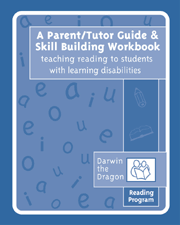
A PARENT/TUTOR GUIDE & SKILL BUILDING WORKBOOK
As the author’s teaching experience clearly indicated that parents of children with learning problems frequently lack guidance and support, the Program was primarily designed for them. To accommodate laypeople, the Guide contains clear teaching instructions, detailed lesson plans, tutor training instructions and a self testing exercise which demonstrates one’s readiness to implement the techniques. Therefore, all that is needed to acquire a firm grasp on the Program is is the willingness to devout approximately 2½ hours acquainting oneself with it. Incidentally, though the Program was designed with parents in mind, teachers, school volunteers and tutors are also finding it to be a valuable tool.
To help parents acquire a better understanding of their children’s problems, the Guide addresses such issues as the nature of learning disabilities; the development of sound homework habits and study skills; promotion; what parents can do when class work and homework are frequently beyond their child’s ability; and as persistent academics difficulties tend to affect social and emotional development, the Guide contains recommendations that allow parents to promote growth in these areas as well.
A workbook with specifically designed exercises and reading materials was created so that each of the Program’s skills can be solidly reinforced.

Should you have any comments or questions, don’t hesitate to contact us.
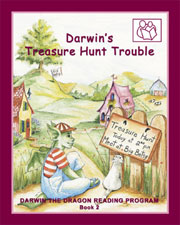
DARWIN’S TREASURE HUNT TROUBLE
The enticement of an adventurous, young, fun-loving dragon and the excitement of a treasure hunt draw the child into the book. Once there, rhyming instructions and delightful illustrations acquaint the child with the short vowels sounds. In addition, the storybook promotes language development and this is achieved through the discussion of the illustrations and storyline. This is an instructional book and thus is to be read to and worked on with the student.
To-date only the first of the three storybooks has been printed; the second and third books will be printed in the near future. Until they are on the market, the tutor should refer to pages 24-28 of the Parent/Tutor Guide for detailed instructions on the teaching of the long vowels and syllabication.

TEACHING AID
The aid consists of five keys that acquaint the student with the short vowel sounds. They come highly recommended as students of all ages find them appealing and thus motivating. They are made out of wood and are approximately 13 cm x 1.9 cm x 1.3 cm (5 in x 2 in x 3/8 in). These keys are available in a less expensive plasticized Bristol board version as well.